August 2026 — Updated Rankings

Best PPC & PPC Management Companies

This is WebDesignRankings' independently evaluated list of the best PPC companies and PPC management agencies, ranked by verified client reviews, platform expertise, and reporting transparency — updated for August 2026. Browse the top 5 below, or jump to the full comparison table.

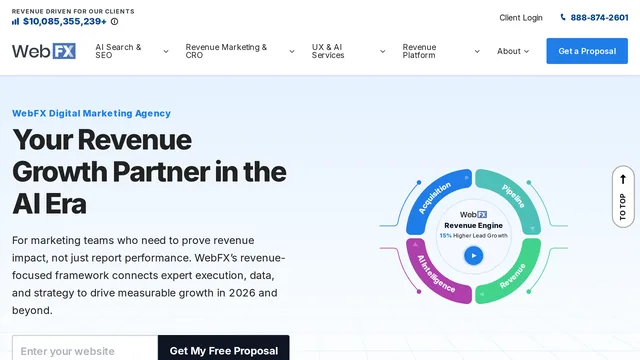
1WebFX – Digital Marketing for the AI Era website screenshot

#1 – WebFX – Digital Marketing for the AI Era

WebFX is a digital marketing agency built for the AI era, with a team of 700+ experts and a focus on growing client revenue rather than channel metrics. The agency reports driving more than $10 billion in revenue and 24 million leads for clients, using strategies powered by RevenueCloudFX and OmniSEO® — its proprietary technology for tracking and growing brand visibility and revenue across AI search engines and other digital channels.

It has been named a top SEO company by Clutch and an Inc. Power Partner in advertising, marketing, and sales.

It holds a 4.7 average across 115 verified reviews in our directory, the deepest review record on this list, and publishes its pricing structure rather than quoting only on a call — rarer than it should be in this category, and it makes proposals easier to compare.

2OpenMoves website screenshot

#2 – OpenMoves

OpenMoves is a small-sized agency based in Huntington, NY. OpenMoves is New York's premier digital marketing agency, offering Paid Search, Organic & Local SEO, Social Media & Email Marketing. Get in touch today.

3Direct Online Marketing website screenshot

#3 – Direct Online Marketing

Direct Online Marketing is a small-sized agency based in Pittsburgh, PA. Direct Online Marketing is an SEO and PPC agency based in Pittsburgh, PA. Google Partner marketing services provider. Grow confidently online! 800.979.3177.

4Thrive Internet Marketing Agency website screenshot

#4 – Thrive Internet Marketing Agency

Thrive is an online marketing agency with a passion to use the power of the Internet to grow your business. Thrive was founded on the conviction that businesses can successfully outshine their competitors with a strong website and an effective online marketing strategy. We provide businesses with expert online marketing and proven results.

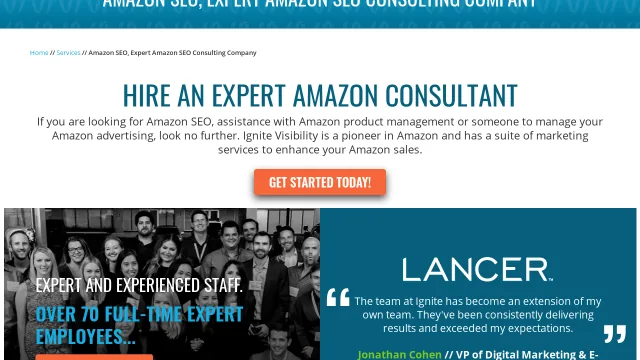
5Ignite Visibility website screenshot

#5 – Ignite Visibility

Ignite Visibility is one of the highest recommended agencies on Clutch.co and one of the top digital marketing companies in the industry. Consistently named one of the top SEO, paid media, social media, email marketing and CRO companies in the USA, Ignite Visibility has used the same strategies they use for clients to become a three-time Inc. 5000 company (2017, 2018 and 2019).

Choosing a PPC management company is mostly a decision about the management agreement rather than the ad copy: how the fee is structured, who owns the ad account, and what happens to your conversion data when the relationship ends. Those three things decide more of your outcome than any campaign tactic, and all three are settled before work starts.

The WDR team evaluated these agencies using our published methodology — verified client reviews, platform expertise, transparency of terms, and years in business. No agency pays to appear on this list.

Each listing below gives you:

  • The firm's location and team size
  • Its average rating and number of verified reviews
  • Its website and full WDR profile for more detail

Then do the arithmetic: the crossover point between a percentage fee and a flat fee is a single division, and it is the difference between the two structures costing the same and one of them costing you thousands more a year. Jump to the full ranking table to compare every agency on the list.

List of the Top PPC Management Companies

Compare ppc companies by size, location, and verified client reviews to find the right fit for your business.

#CompanySizeLocationReviewsOverview
1700+ expertsPennsylvania★★★★
115 Reviews
View Profile
210 – 49Huntington, NY
0 Reviews
View Profile
310 – 49Pittsburgh, PA
0 Reviews
View Profile
410 – 49Arlington, TX★★★★
79 Reviews
View Profile
510 – 49San Diego, CA
0 Reviews
View Profile
610 – 49Elgin, IL
0 Reviews
View Profile
750 – 249Costa Mesa, CA
0 Reviews
View Profile
850 – 249Lindon, UT
0 Reviews
View Profile
910 – 49Costa Mesa, CA
0 Reviews
View Profile
1010 – 49Menomonee Falls, WI
0 Reviews
View Profile
112 – 9Los Angeles, CA
0 Reviews
View Profile

Want to know exactly how we built this list? See our full ranking methodology below.

How We Rank These PPC Management Companies

We evaluate ppc companies the same way we evaluate agencies anywhere: by verified results, not by who pays the most. Here's what we weighed:

  • Client track record. Verified reviews and ROAS/CPA results, not just campaign spend numbers.
  • Platform expertise. Real experience across Google Ads, Microsoft Ads, and Meta Ads, with certifications to back it up.
  • Reporting transparency. Whether an agency reports on ROAS and CPA, not just impressions and clicks.
  • Affordability. Pricing relative to ad spend and results delivered.

We treated platform partner badges as a hygiene signal rather than a ranking factor. They are awarded against programme criteria the platforms set — certification counts, managed spend, account activity — not against an audit of client outcomes, so a badge tells you an agency clears a threshold, not that it will do well by you.

No agency pays for placement on this list. See our full ranking methodology for more detail.

Percentage of spend versus flat fee: the crossover, worked out

Every guide to hiring a PPC agency tells you to ask which fee model they use. None of them tell you what to do with the answer. It is one calculation.

The two structures are equal at exactly one monthly spend level: the flat fee divided by the percentage rate. Below it, the percentage is cheaper. Above it, the percentage costs more, every month, forever — and by more each time you increase budget.

Flat fee quotedAt a 15% rate, equal when spend isAt 12%At 20%
$1,500 / month$10,000$12,500$7,500
$3,000 / month$20,000$25,000$15,000
$5,000 / month$33,300$41,700$25,000
$10,000 / month$66,700$83,300$50,000

Read one row. A $3,000 flat fee and a 15% management rate cost you the same at $20,000 of monthly media. At $50,000 of spend, the percentage model costs $7,500 a month — $54,000 a year more than the flat fee — for an account that has not necessarily become harder to manage in proportion.

What this means in practice

  • If your spend is stable and below the crossover, percentage is usually the better deal and carries less risk if you pause campaigns.
  • If you plan to scale spend, negotiate a flat fee or a tiered rate now, while you are still the smaller party. Percentage agreements are hardest to renegotiate at precisely the moment they start costing you.
  • Watch the minimum. Most percentage agreements carry a floor. A 15% rate with a $2,000 minimum is a flat $2,000 fee until your spend passes $13,300, whatever the contract calls it.
  • Note the incentive, without over-reading it. A percentage agreement rewards your agency for spending more of your money. Most agencies do not behave badly because of it, but it is the structure you are signing, and it belongs in the conversation about scaling budget.

The threshold where an agency stops making sense at all

Add the management fee to the media spend and work out what share of the total is going to management. At $4,000 of monthly spend with a $2,000 minimum fee, a third of your paid budget is buying management rather than clicks — and the account needs to perform roughly 50% better than a self-managed one just to break even against doing it yourself badly. That can absolutely be worth it. But it is the calculation to run before signing, and no agency will run it for you.

The clause that matters more than the fee

Who owns the ad account. If the agency builds your campaigns inside an account it owns, then at the end of the relationship you can lose the campaign history, the conversion data, and the learning period that history represents — and you start again from zero with the next agency. This is avoidable in three steps, all of which must happen before work starts:

  • You create the ad accounts, in your company's name and billing, and grant the agency administrative access. An agency managing through its own manager account is fine; an agency owning the account underneath is not.
  • Conversion tracking lives in your property. Conversion actions, tags, and analytics in your own containers and your own accounts. If conversions are defined inside the agency's systems, the reported return on ad spend is a number only they can verify — and it disappears with them.
  • Get an offboarding clause in writing. What is handed back, in what format, within how many days. Ask during the sales process, when you have leverage.

What PPC management actually includes

Anyone can launch a campaign. The retainer buys the ongoing part: watching what the platform's automation does with your money, correcting it, and keeping the measurement honest enough that you can tell. Most of the value in a good engagement is in these cycles, and most of the loss in a bad one comes from nobody performing them. Read a proposal against this list and note what is missing.

Search terms and negatives

Reviewing which queries actually triggered your ads and excluding the ones that will never convert. With broad match and automated bidding this is now the main lever protecting your budget, and it is the first thing that quietly stops happening on a neglected account.

Conversion tracking integrity

Confirming conversion actions fire once, count the right thing, and are not counting form loads or junk submissions. Automated bidding optimises toward whatever you tell it a conversion is — broken tracking does not produce bad reporting so much as a bad account.

Budget pacing and bid strategy

Managing spend across campaigns through the month and changing bid strategies as data accumulates, rather than setting a strategy at launch and letting it run.

Creative and landing page testing

Ad variants, extensions, and the page after the click. Frequently the cheapest available improvement is on the landing page rather than in the account — check whether landing page work is in scope, because often it is not.

Audience and exclusion management

Remarketing lists, customer lists, and placement exclusions on display and video. Exclusions are where a surprising share of wasted spend hides.

Reporting you can reconcile

Numbers you can tie back to the ad platform and to your own analytics or CRM. If the monthly report cannot be reconciled against a source you control, you are being asked to accept performance on trust.

How to Vet a PPC Management Company Before You Hire

A polished pitch isn't proof of results. Use these checks before signing a contract.

  • Ask whether the ad accounts will be in your name

    Ask before anything else. You want to create the accounts and grant the agency access, not inherit access to an account it owns. Campaign history is an asset you paid to build, and it does not transfer if the account was never yours — you start the next agency from zero.

  • Ask where conversion actions live

    In your analytics property and your tag container, not theirs. Otherwise the return on ad spend in your monthly report is unverifiable by anyone but the agency, and it vanishes at offboarding along with your ability to check it.

  • Ask for real ROAS results, not just spend numbers

    Managing a big budget doesn't mean good results. Ask for return-on-ad-spend or cost-per-acquisition improvements for accounts similar in size and industry to yours.

  • Ask who's actually managing your account

    Many agencies hand client accounts to junior staff after the sales pitch. Ask directly who will run day-to-day optimization and how often you'll hear from them.

  • Check platform certifications

    Google Premier Partner status and Microsoft Advertising certifications signal a baseline of platform expertise — though certifications alone don't guarantee results.

  • Get specific about the fee structure

    A flat monthly fee and a percentage-of-ad-spend model create different incentives. Ask which model an agency uses and why.

  • Ask how they're using AI bidding and creative tools

    Automated bidding and AI-generated ad copy are now central to paid search. Ask how an agency balances that automation with human strategy and oversight.

Frequently Asked Questions About PPC Management Companies

What Does a PPC Management Agency Actually Do?

A PPC management agency plans, launches, and continuously optimizes paid search and paid social campaigns — keyword and audience targeting, bid management, ad copy and creative, landing page alignment, and performance reporting — so your ad spend converts instead of just generating clicks.

How Much Does PPC Management Cost?

Two structures dominate: a percentage of ad spend, typically quoted somewhere around 10–20% with a monthly minimum, or a flat monthly retainer. Neither is inherently better, and the two are equal at exactly one spend level — the flat fee divided by the percentage rate. A $3,000 fee and a 15% rate cost the same at $20,000 of monthly media; above that the percentage costs more every month. The full crossover table is above. Hourly consulting exists as a third option and suits audits and one-off fixes rather than ongoing management.

Agencies typically charge either a flat monthly fee (often $1,000 to $10,000+ depending on account complexity) or a percentage of ad spend (commonly 10% to 20%). Neither model is inherently better — ask which one an agency uses and how it affects their incentives as your budget grows.

Is AI Changing PPC Management?

As of August 2026, yes — automated bidding strategies and AI-assisted campaign types now handle much of the minute-to-minute optimization that used to be manual. That hasn't made PPC management obsolete; it's shifted the value of a good agency toward strategy, creative, and knowing when to override the automation, not away from it. Ask any PPC company how they combine automation with human judgment.

Does a Google Premier Partner badge mean better results?

It means the agency meets Google's programme requirements — certification levels, managed spend across its client base, and account activity thresholds — and sits in the top tier of participating partners. It is not an audit of client outcomes, and a large agency clears the spend threshold on volume regardless of how any individual account performs. Treat it as a hygiene check rather than evidence, and ask for client references either way.

Should we manage PPC in-house instead?

Run the share-of-budget test. Add the management fee to the media spend: if management is taking 25–35% or more of the total, the account has to perform substantially better than a self-managed one just to break even, and at small budgets it often will not. Above roughly $10,000 a month in spend the calculation usually flips the other way, because a single structural mistake costs more than the fee.

How long before we can judge a new PPC agency?

Give it 90 days, and agree in advance what you are judging. Automated bidding needs a conversion history before it stabilises, and an agency inheriting a broken account will spend the first month on tracking rather than performance. What you can reasonably expect inside 30 days is a documented audit, clean conversion tracking, and a written plan — not a better cost per acquisition.