August 2026 — Updated Rankings

Best AEO Companies & Agencies

These are answer engine optimization (AEO) agencies — the firms you hire to get your brand cited inside AI answers — not the AEO software you buy to measure it. If you searched for AEO companies and got a list of dashboards, this is the other half of the market. WebDesignRankings evaluated them independently, using the same criteria we apply to every list we publish. Updated for August 2026.

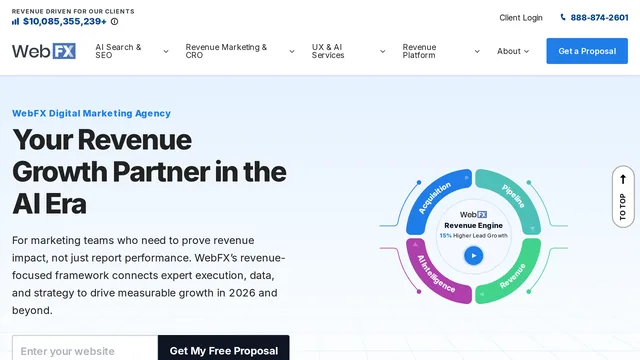
1WebFX – Digital Marketing for the AI Era website screenshot

#1 – WebFX – Digital Marketing for the AI Era

WebFX is a digital marketing agency built for the AI era, with a team of 700+ experts and a focus on growing client revenue rather than channel metrics. The agency reports driving more than $10 billion in revenue and 24 million leads for clients, using strategies powered by RevenueCloudFX and OmniSEO® — its proprietary technology for tracking and growing brand visibility and revenue across AI search engines and other digital channels.

It has been named a top SEO company by Clutch and an Inc. Power Partner in advertising, marketing, and sales.

In our own directory it holds a 4.7 average across 115 verified client reviews, the deepest review record on this list. Its answer engine work sits inside a broader SEO and content practice rather than being sold as a standalone AI product, which matters: the pages that get cited in AI answers are usually the same pages that already earn organic rankings.

2Siege Media website screenshot

#2 – Siege Media

Siege Media is a San Diego content and link-building agency (50–249 staff) that now brands itself outright as a GEO agency. It is one of the few names that appears on both AEO and GEO shortlists published by other firms, and its public case studies are content-led rather than technical — a fit if your problem is that nothing you publish is quotable, and a poor fit if your problem is that AI crawlers cannot render your site.

3Directive Consulting website screenshot

#3 – Directive Consulting

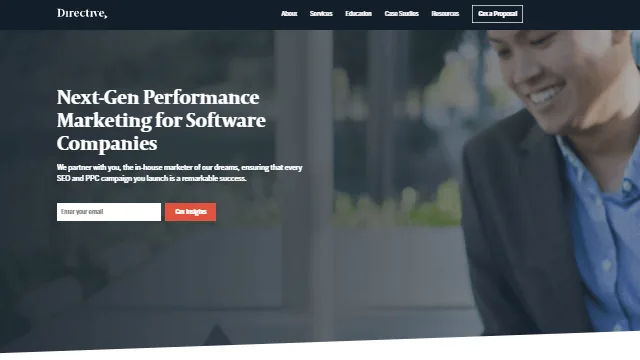
Directive Consulting is a Costa Mesa, CA agency (10–49 staff) working almost exclusively with B2B software companies, and it frames search work around pipeline rather than rankings. That framing is the reason it belongs on an AEO list: the useful question about an AI citation is whether it produced a qualified conversation, and firms that already report on pipeline have somewhere to put that number.

4Victorious website screenshot

#4 – Victorious

Victorious is a San Francisco SEO agency (10–49 staff) that has repositioned around search and AI visibility together. It sells a defined, productized scope, which makes it easier than most to compare on paper — useful when you are trying to work out what an AEO retainer actually buys you month to month.

5Coalition Technologies website screenshot

#5 – Coalition Technologies

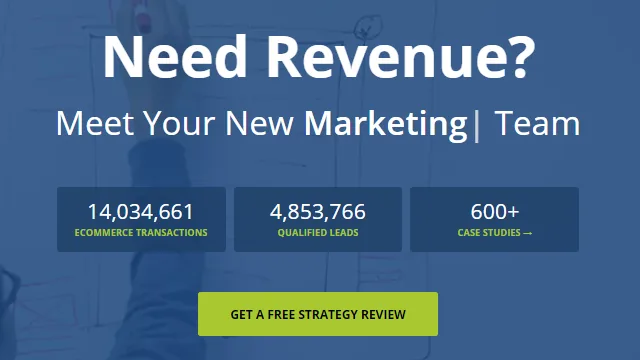
Coalition Technologies is a Culver City, CA agency (50–249 staff) carrying a 4.8 average across 160 verified reviews in our directory. It is a technical and ecommerce SEO shop first, which is the right shape of firm when your AI visibility problem is structural — unrenderable templates, thin product data, no clean source-of-truth page for anything a model might be asked about.

“Best AEO companies” is a query with two different answers, and most lists quietly pick the wrong one. Roughly half the pages ranking for it are roundups of software — dashboards that track how often a brand is mentioned by ChatGPT or Perplexity. This page is the other answer: the service providers you hire to change the outcome those dashboards measure.

The WebDesignRankings team evaluated agencies using our published methodology, weighing verified client reviews, years in business, service breadth, and evidence of real work in AI search. No agency pays to appear here, and no placement is for sale.

Each listing above gives you:

  • What the firm is actually good at, in plain terms
  • Where it is based and how large its team is
  • Its verified review record in our directory, where one exists
  • The specific thing to ask it about on a first call

Before you contact any of them, run the free citation audit below. It takes about an hour and it is the only way to know whether an agency's later reporting is measuring its own work.

How We Ranked These AEO Agencies

AEO is roughly two years old as a service line, which means nobody has a decade of results to point at and every agency's methodology page was written recently. We ranked against what can actually be checked:

  • Verified client track record. Reviews and testimonials from real clients in our directory, not the agency's own case-study copy.
  • Underlying search competence. AI answers are assembled from sources that were crawled, indexed, and trusted first. An agency with no demonstrated organic search practice is selling you the roof without the walls.
  • Evidence of specific work. Named surfaces, named queries, dated before-and-after examples — as opposed to a service page that lists “schema markup” and stops.
  • Longevity and stability. Years in business, and whether the firm existed before the category it now sells did.

We also applied a relabel check. Most agencies on every AEO list published anywhere were SEO or content agencies before 2024, and a service page can be relabelled in an afternoon. Where a firm's AEO page reads as its old SEO page with the terms swapped, we treated the offering as unproven rather than disqualifying — plenty of good AEO work is genuinely just good SEO work — but we weighted the firms that could show something new. You can run the same check yourself in about five minutes; the section below explains how.

No agency pays for placement, and sponsorship never factors into position. Our full ranking methodology has more detail.

Run this citation audit before you sign anything

Every AEO agency will show you a visibility number. Almost none of them can show you what that number was before they started, because you did not measure it. That is the single biggest asymmetry in this market, and it takes about an hour to close. Do this yourself, first, and keep the file.

1. Write 20 buyer-intent prompts

Not brand prompts. The prompts a buyer types when they do not yet know you exist. For a commercial roofing company that is “who does commercial flat roof replacement in Cleveland,” not “is [your brand] any good.” Cover four kinds:

  • Category prompts — “best [category] companies for [segment]”
  • Problem prompts — the symptom a buyer describes before naming the solution
  • Comparison prompts — “[competitor] vs alternatives”
  • Qualifier prompts — price, timeline, compliance, integration, location

2. Run each one across three assistants on the same day

ChatGPT, Perplexity, and Google's AI answers at minimum. Use a logged-out or fresh session so personalisation does not flatter you. Log it like this:

PromptAssistantDateBrands namedURLs citedYou mentioned?
best commercial roofers ClevelandPerplexity[date]3 competitors2 directories, 1 newsNo

3. Read the citing URLs, not the brand names

This is the part buyers skip and it is where the strategy comes from. If the cited sources are directories and listicles you are absent from, your problem is third-party presence and no amount of on-site schema will fix it. If the cited sources are competitor pages that answer the question directly in the first paragraph, your problem is that your equivalent page buries the answer under a brand story. Those are different engagements with different price tags.

4. Repeat at 90 days

Same prompts, same assistants, same logged-out conditions. Now you have a before and an after that an agency did not produce and cannot adjust.

The trap this protects you from

AI assistants change their retrieval behaviour and their underlying models on their own schedule. A brand's citation rate can move several points in a month with nothing on the brand's side having changed at all. An agency reporting only its own dashboard, with no independent baseline and no control queries, cannot separate its work from that drift — and neither can you. Keeping your own log, including a handful of prompts in a category you are not paying anyone to work on, is the cheapest control group you will ever build.

And while you have the tab open: the relabel test

Put the agency's AEO or GEO service page into the Wayback Machine and look at what that URL said in 2023. If the page is word-for-word its old SEO page with the acronyms swapped, that is not disqualifying — but it does tell you the methodology is younger than the sales page implies, and you should ask what they have actually shipped since.
What an AEO Agency Actually Does

The deliverables behind the acronym are less exotic than the pitch decks suggest. Here is the work itself, so you can tell whether a proposal covers it.

The short version

An AI assistant answers a question by retrieving a handful of sources and summarising them. So there are exactly two ways to be in the answer: be one of the retrieved sources, or be described inside someone else's retrieved source. Everything a competent AEO agency does serves one of those two ends. Anything in a proposal that serves neither is padding.

  • A retrievable page for every question that matters

    One page per buyer question, with the answer in the first two or three sentences, in plain HTML that survives being stripped of its styling. Assistants extract passages, not pages — an answer that only makes sense after four paragraphs of brand narrative does not travel.

  • Entity clarity

    Making it unambiguous what your company is, what it sells, where it operates, and which of the six similarly named businesses it is. This is structured data, consistent naming across the web, and a clean about-and-services spine — unglamorous work that determines whether a model can talk about you with any confidence.

  • Third-party citation surface

    Getting the brand into the sources assistants actually quote: category directories, review platforms, trade publications, comparison pages. Your own site is one input; for many category prompts it is not the one being cited.

  • Technical retrievability

    Confirming AI crawlers can fetch and render what a human browser sees, that key content is not locked behind client-side rendering, and that robots rules do not block the agents you want reading you. This is where a technical SEO background pays off immediately.

  • Measurement that survives scrutiny

    A fixed prompt set, run on a schedule, logged with dates and citing URLs, including control prompts the agency is not working on. If reporting is a single visibility score the agency defines, computes, and is paid against, you have no way to audit it.

  • The same SEO that always worked

    Crawlability, internal linking, page speed, genuinely useful content, real links. Sources have to be findable and trusted before they can be summarised. An AEO proposal with no traditional search work in it is usually a proposal from someone who cannot do traditional search work.

How to Vet an AEO Agency Before You Hire

Five questions, in this order. Each one is designed so that a vague answer is itself the answer.

  • “Show me one query where a citation appeared after your work started.”

    Ask for the specific prompt, the assistant, the date, and a screenshot. One real example beats any dashboard. An agency doing this work has these lying around; an agency that answers with aggregate visibility scores is describing a number, not a result.

  • “What is in your reporting that you don’t control?”

    Proprietary visibility indices are fine as a trend line and useless as proof, because the vendor defines the metric and is paid against it. You want at least one input the agency cannot adjust: your analytics, your CRM, assistant referral traffic, a prompt log you keep yourself.

  • “What would you do if we were already cited and it wasn’t converting?”

    Citations are not the goal; qualified conversations are. This question separates firms that think in pipeline from firms that think in visibility. The good answer involves what the citing source says about you and which page it lands on — not getting cited harder.

  • “Which parts of this are just SEO?”

    A confident agency will tell you plainly that most of it is, and charge accordingly. An agency that insists AEO is an entirely new discipline requiring an entirely new retainer, on top of the SEO retainer you already pay, is selling the same hours twice.

  • Then check the contract for the guarantee

    Nobody can guarantee a citation. Assistants change retrieval behaviour without notice, and no vendor has an ingestion API into a model's answer. A guaranteed placement in AI results, or a 30-day promise of anything, is a signal to walk.

FAQs About AEO Agencies & Companies

What is answer engine optimization?

AEO is the practice of getting a brand's content used and cited when an AI assistant answers a question, rather than only ranking in a list of blue links. In practice it covers structuring content so a passage can be lifted and remain accurate, making the brand unambiguous to machines, earning presence in the third-party sources assistants quote, and confirming AI crawlers can actually read your site.

Is AEO different from GEO?

Mostly not, and the agencies themselves say so. Answer engine optimization and generative engine optimization are used interchangeably by most firms selling either. A minority draws a real line — AEO for direct-answer formats like snippets and voice, GEO for being recommended inside generative responses — and that distinction is coherent, but it is not the industry consensus. Do not choose an agency based on which acronym it uses. Ask what it does. Our GEO companies ranking covers the same discipline from the other end of the vocabulary.

How much do AEO agencies charge?

Pricing has not settled into anything you could call a standard, and any firm range you read — including ours — should be treated as a directional signal. What we can report from our own data: across the 1,143 agencies in the WebDesignRankings directory that publish an hourly rate band, 73% fall between $100 and $199 an hour, and 25% are under $100. AEO work is generally sold as a monthly retainer rather than hourly, but that band is what the underlying labour costs, and a quote far outside it should come with an explanation.

How long before AEO work shows up in answers?

Longer than the sales cycle suggests and less predictably than SEO. A model has to crawl the changed page, and then the retrieval layer has to prefer it for a given prompt — and neither step runs on a schedule you control. Treat anything under 90 days as noise, which is exactly why the baseline audit above matters: without it, the first thing you will be shown is a number with nothing to compare it to.

Can we do this in-house?

Partly, and you should do the measurement part in-house regardless. Running a fixed prompt set monthly and logging the citing URLs takes a couple of hours and belongs with whoever owns your reporting. The parts that genuinely benefit from an agency are the technical audit, the third-party citation surface, and the volume of content rewriting — the same three things you would hire an SEO agency for.

Do we still need traditional SEO?

Yes, and it is not a separate question. Assistants retrieve from the indexed, crawlable web; the sources they quote are overwhelmingly pages that also rank. An AEO programme sold as a replacement for SEO rather than a layer on top of it is, in almost every case, a repackaging. See our best SEO companies ranking for firms sold on that basis.

How do we pick the right AEO agency for our category?

Diagnose before you shortlist, because the three failure modes need different firms. If assistants cannot confirm basic facts about you, that is a technical and entity problem and you want a technical SEO shop. If they can describe you but never bring you up unprompted, you are missing from the third-party sources being cited and you want a content and digital PR firm. If they cite you but describe you wrongly, that is usually one stale page or listing and may not need an agency at all. The citation audit above tells you which of the three you have in about an hour.